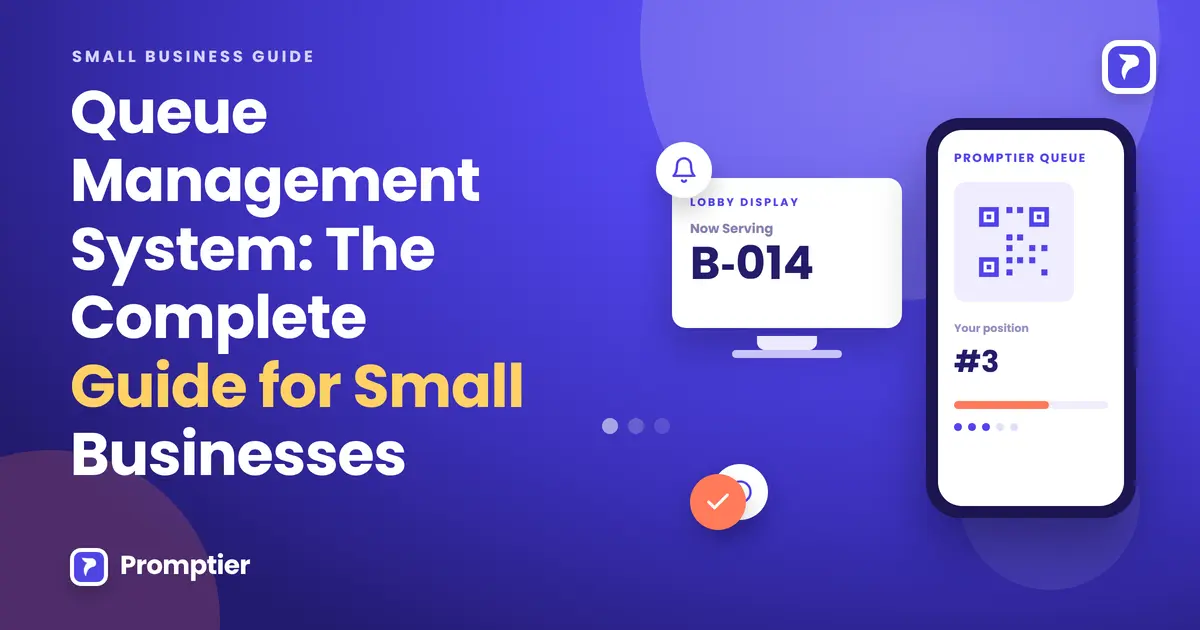
Most small businesses that run on walk-ins — barbershops, clinics, restaurants, single-branch banks — still manage their line the same way they did a decade ago: a paper sign-in sheet, a token dispenser, or a staff member shouting “next.” Meanwhile, the customer standing in that line has a phone in their pocket that could tell them exactly how long the wait is, and let them wait somewhere other than the doorway. A queue management system is the software (and sometimes hardware) that closes that gap: it lets customers join a line remotely, see their position and estimated wait, get notified when it’s their turn, and gives the business a live view of demand instead of a guess.
This guide is for owners and managers of small and growing service businesses — not enterprise IT buyers evaluating a bank-wide rollout. You’ll learn what a queue management system actually is, the real benefits it delivers, how it works end to end, the 8 features worth paying for, and the mistakes that turn a good idea into an ignored app nobody uses.
The numbers back up why this matters. Customers report waiting as the single most frustrating part of visiting a business, and 86% say they’ll switch to a competitor after a bad wait experience. The global queue management system market is projected to grow from roughly USD 43.67 billion in 2026 to USD 77.13 billion by 2031, and Asia-Pacific — India included — is the fastest-growing region. The businesses adopting this early aren’t doing it for the technology. They’re doing it because a five-minute cut in wait time measurably brings customers back.
Key Takeaways
- A queue management system lets customers join a line remotely (QR code, link, or kiosk), see live wait estimates, and get notified when it’s their turn — instead of standing in a physical line.
- 73% of customers say waiting is the most frustrating part of visiting a business, and 86% will switch providers after a bad wait experience, according to 2026 customer-waiting research.
- You don’t need enterprise pricing to get enterprise-grade queuing. Small businesses can run a full digital queue — QR joining, SMS alerts, TV display, analytics — for a few hundred rupees a month, not a multi-lakh annual contract.
- Real-time wait-time transparency reduces how long a wait feels by around 35%, even when the actual wait doesn’t change — perceived wait time matters as much as actual wait time.
- A queue management system only pays off when it changes something operationally: staffing at peak hours, which services need more people, or which days need a second person at the counter. A digital queue nobody looks at is just a fancier paper list.
What Is a Queue Management System?
A queue management system is software (often paired with simple hardware like a TV display or kiosk) that lets customers join a line digitally, shows them a live wait estimate, notifies them when it’s their turn, and gives the business real-time and historical data on customer flow.
At its core, every queue management system answers four questions for the customer: where am I in line, how long will it take, do I need to stand here, and how will I know when it’s my turn. And it answers a parallel set of questions for the business: how many people are waiting right now, which staff member should serve them, when are we about to get busy, and where in the process do people get frustrated or leave.
Queue management systems break into two layers. The software layer includes online and walk-in queue joining, virtual queuing via QR code or SMS, automated wait-time estimates and notifications, staff-to-service assignment, and analytics on visits, no-shows, and peak hours. The hardware layer, which is optional for most small businesses, includes self-service kiosks, ticket printers, and TV or tablet displays showing “Now Serving.”
The distinction that matters most for a small business is between a queue and a line. A line requires physical presence — you have to stand there to hold your place. A queue is just an ordered list of who’s next; it doesn’t require anyone to be standing anywhere. Digital queue management systems turn a line into a queue, which is the entire point: the customer’s time is freed up, and the business still serves people in the correct order.
Key definitions you’ll see throughout this guide:
Actual wait time: the real, measured duration a customer waits before being served.Perceived wait time: how long the wait feels to the customer — often longer or shorter than the actual time, depending on visibility and communication.Virtual queue: a queue a customer joins remotely (QR code, link, SMS) and can wait through without being physically present.No-show rate: the percentage of customers who join a queue or book an appointment and never arrive to be served.
Why Queue Management Matters for Small and Growing Businesses
Queue management matters because an unmanaged line is a silent source of lost customers — most of whom never complain, they just don’t come back. Small businesses that digitize their queue typically recover walk-aways, cut perceived wait time, and get their first real data on foot traffic.
Consider what an abandoned queue actually costs a small business. Customers tolerate a wait of roughly 8 minutes on average before leaving, though the threshold varies by category — around 10 minutes in retail, 25 minutes at a salon or barbershop, and up to 20 minutes past an appointment time at a clinic. Every customer who leaves during that window isn’t a complaint you’ll hear; they’re a booking you’ll never see. Industry research puts the toll from wait-driven walkouts at tens of thousands of dollars a year for a mid-sized walk-in business, and 30% of customers who leave a queue don’t come back within 30 days.
Queue data also settles disagreements that otherwise run on gut feeling. When a barbershop owner insists Saturdays “aren’t that busy” but the queue log shows a 22-minute average wait between 11 AM and 1 PM every single Saturday, the conversation about adding a second chair on weekends changes completely. That’s not a guess anymore, it’s a pattern.
There’s an honest limitation here too: a queue system tells you that people are waiting and when, not always why. A growing wait time could mean you’re understaffed, a specific service is taking longer than scheduled, or you’re simply busier than you were three months ago and it’s a good problem to have. The system tells you where to look. It doesn’t replace looking.
📊 Key Stat: Negative wait experiences generate roughly 2.5x more online reviews than positive ones. For a small, locally-searched business, that asymmetry means a handful of bad wait days can do outsized damage to a Google rating that took years to build.
Key Benefits of a Queue Management System
The primary benefit of a queue management system is a shorter, less frustrating wait — for the customer and the business alike — because appointments and walk-ins are scheduled around real demand instead of guesswork, with real-time notifications and displays cutting how long a wait feels by around 35%.
Better resource allocation. Appointment scheduling built into the queue system means you know how many people to expect and when, instead of reacting to whoever walks through the door.
Shorter actual wait times. Live tracking of who’s in line and how long each service takes surfaces bottlenecks — a specific chair, a specific counter, a specific time slot — that a paper list simply can’t show you.
Less anxiety, more patience. SMS and push notifications tell customers exactly where they stand, and research shows 59% of customers will tolerate a longer wait if they’re getting progress updates along the way.
Lower perceived wait time. A TV or lobby display showing live queue status makes the same 15-minute wait feel shorter, because uncertainty — not just duration — is what customers find frustrating.
Freedom to wait anywhere. A mobile ticket or QR-based queue lets a customer run an errand, sit in their car, or grab a coffee instead of standing at your door. 67% of customers now prefer this kind of smartphone-based queuing over a physical line.
Smarter staffing decisions. Real-time and historical queue data shows you exactly when your peak hours are, so you can schedule staff around demand instead of a fixed roster that’s wrong half the week.
The right staff for the right customer. Matching a customer’s need to the staff member trained for it — a specific stylist, a specific doctor, a specific service counter — cuts down on re-routing and wasted time.
A more personal experience. Recognizing repeat customers and their usual service or preferences, something a digital system can do automatically that a paper sheet never could.
Visibility into what’s actually broken. Queue and no-show data expose exactly where customers drop off — a long gap before appointments, a specific day that’s chronically overbooked — long before it shows up in a bad review.
| Dimension | Without a Queue System | With Digital Queue Management |
|---|---|---|
| Wait visibility | Customer has no idea how long it’ll take | Live position and wait estimate on their phone |
| Staffing | Fixed schedule regardless of demand | Staffing adjusted to real peak-hour data |
| No-shows | Untracked, absorbed as “normal” | Tracked, with reminders that reduce them |
| Customer experience | Stand in a physical line | Wait anywhere, get notified when it’s time |
| Business insight | Owner’s gut feeling | Actual visit, wait-time, and peak-hour data |
💡 Pro Tip: If you can only start with one feature, start with SMS/push notifications. It’s the cheapest change to make and the one customers notice first — knowing they don’t have to watch the door is often the single biggest satisfaction driver in the whole system.
How a Queue Management System Works: From Walk-In to Served
A queue management system runs on a simple four-stage loop: a customer joins the queue (QR code, link, or walk-in), waits wherever they want while the system tracks their position, gets notified as their turn approaches, and is served — with every step logged for later analytics.
Stage 1: Join
Input: A customer arriving at your shop, or opening your booking link from home.
Process: The customer scans a QR code at the door, taps a link, or is added to the queue by staff for a true walk-in. No app download is required — this single detail is what determines whether customers actually use the system or quietly ignore it.
Output: A ticket with a queue position and an estimated wait time, visible instantly on the customer’s own phone.
Stage 2: Wait
Input: The ticket from Stage 1 and the current queue state.
Process: The customer is free to leave the premises. The system recalculates their estimated wait continuously as the queue moves, based on real service times, not a fixed average.
Output: A live, self-updating wait estimate the customer can check anytime, with no need to ask staff “how much longer.”
Stage 3: Notify
Input: The customer’s live position and your configured “heads-up” threshold (for example, notify at 3 people remaining).
Process: An SMS or push notification fires automatically as their turn nears, giving them time to walk back without rushing or missing their slot.
Output: A customer who arrives at the counter right when it’s their turn — not 15 minutes early, not after being skipped.
Stage 4: Serve
Input: The customer’s arrival and the staff member assigned to their service.
Process: Staff calls the customer via the TV/lobby display or an in-app alert, and the visit is logged — service type, staff member, actual wait time, and duration.
Output: A completed, timestamped visit record that feeds directly into your analytics dashboard.
| Stage | Cadence | Owner | Typical Tooling |
|---|---|---|---|
| Join | Continuous | Customer (self-service) | QR code, booking link, staff-added walk-in |
| Wait | Continuous | System | Live queue position, wait estimate |
| Notify | Automated, threshold-based | System | SMS / push notification |
| Serve | Per visit | Staff | TV/lobby display, call-to-serve |
Best Practices for Implementing a Queue Management System
The single most impactful practice is making joining the queue effortless — no app download, no account creation. A queue system customers find annoying to join gets abandoned in favor of just standing in line, which defeats the entire purpose.
Remove every barrier to joining. Before: a system that requires downloading an app and creating an account, so only a fraction of walk-ins ever use it. After: a QR code or link that opens straight to the queue, no install required. Businesses that drop the app requirement see meaningfully higher queue adoption in the first week alone.
Combine appointments and walk-ins in one queue. Before: appointment customers and walk-ins are managed on two separate systems, so staff can’t see the true picture of who’s waiting. After: both flow into a single queue view, so a walk-in isn’t accidentally served ahead of a booked appointment, or vice versa.
Set a realistic notification threshold. Before: customers are notified only when it’s literally their turn, giving them no time to walk back. After: a “3 people ahead” heads-up notification, so customers arrive on time instead of scrambling.
Segment by service type, not just by counter. Before: one blended queue hides the fact that a specific service (a haircut-and-color, a specialist consultation) is what’s actually driving long waits. After: service-level data shows exactly which offering needs a schedule adjustment.
Put the display where customers can actually see it. Before: a queue status screen tucked behind the counter that only staff can see. After: a TV or tablet visible from the waiting area — visible progress is what lowers perceived wait time, not the software running in the background.
Review the data monthly, not just when something breaks. Before: the analytics dashboard is opened only after a bad Google review. After: a 15-minute monthly look at peak hours, no-show rate, and average wait, so staffing decisions are proactive instead of reactive.
⚠️ Watch Out: The most common failure mode isn’t picking the wrong software. It’s picking the right software and never looking at the data it collects. If a quarter passes with no staffing or scheduling change traceable to your queue data, you’ve bought a nicer-looking token machine, not a queue management system.
| Condition | Recommended Action | Expected Outcome |
|---|---|---|
| High walk-away rate during a known peak window | Add staff or a second service point during that window | Fewer walkouts without hiring full-time |
| Customers confused about how to join | Put a large, visible QR code at the entrance and on the website | Higher self-service queue adoption |
| High no-show rate on booked appointments | Turn on automated SMS reminders 24 hours and 1 hour before | No-shows typically drop noticeably within weeks |
| One service consistently backs up the whole queue | Segment that service into its own sub-queue or add a specialist | Overall average wait time recovers |
Common Challenges and How to Solve Them
The most common challenge is low adoption — customers defaulting back to standing in line because joining digitally felt like more effort than just waiting. Every other challenge is smaller than this one.
Challenge: Customers Don’t Use It
If the queue system requires an app download, an account, or more than a few taps, most walk-in customers will simply stand in line the old way. Solution: use a no-app, QR-code-or-link system, and put a physical sign at the entrance explaining it takes 10 seconds.
Challenge: Staff Reverts to the Old Way During Busy Periods
Under pressure, it’s tempting for staff to just call out names instead of using the system. Solution: make the digital call-to-serve faster than shouting — a one-tap “call next” button and an auto-updating TV display remove the friction that causes staff to skip it.
Challenge: Data Looks Wrong or Inconsistent
Manually added walk-ins, forgotten “mark as served” steps, and duplicate entries quietly corrupt your wait-time and staffing data. Solution: a short weekly habit of checking that every visit was properly closed out keeps the numbers trustworthy.
Challenge: One Bad Day Skews the Averages
A single unusually busy Saturday, or a day with a staff no-show, can make your monthly average wait time look far worse than a normal day actually is. Solution: look at the trend over several weeks, and note outlier days rather than reacting to any single day’s number.
Challenge: No Time to Look at the Dashboard
Owners running the counter themselves rarely have time to dig through analytics at the end of a long day. Solution: pick one number to check weekly — average wait time or no-show rate — instead of trying to review everything.
Real-World Use Cases
Small businesses that switch from paper or token queues to a digital system typically recover walk-aways within the first month and get their first real visibility into peak-hour staffing needs within a quarter.
Independent barbershop, 3 chairs. Problem: Saturday walk-ins routinely backed up 25+ minutes, and the owner suspected — but couldn’t prove — that customers were leaving without saying anything. Intervention: switched from a paper sign-in sheet to a QR-code queue with SMS alerts, letting customers wait at the café next door. Outcome: queue data confirmed a consistent 11 AM–1 PM surge every Saturday; adding a part-time third chair during that window cut the average Saturday wait roughly in half, and no-shows for the newly added slot-based bookings stayed near zero because of automated reminders.
Single-location dental clinic. Problem: patients frequently arrived on time only to sit in the waiting room 20+ minutes past their appointment, generating friction at check-in and a steady trickle of one-star reviews mentioning “long waits.” Intervention: moved to appointment-plus-walk-in queue management with a lobby display and SMS updates when the clinic was running behind. Outcome: patients reported feeling less frustrated even on days the actual wait didn’t change, because they could see their position and got proactive notice of delays — reflecting the same perceived-wait effect seen broadly in customer research.
Small private bank branch. Problem: a single branch handling both quick transactions (passbook updates, cash deposits) and long ones (loan consultations) in one line meant a five-minute customer routinely waited behind a forty-minute one. Intervention: split the queue by service type, so quick transactions and consultations moved through separate lines feeding the same counters. Outcome: average wait time for routine transactions dropped sharply, and staff could see at a glance which service type was backing up and reassign a teller accordingly.
💡 Pro Tip: All three examples share the same root fix: segmenting the queue by service type or time window. Before adding staff or hours, check whether your real problem is one specific bottleneck hiding inside a single blended line.
8 Features to Look for in a Queue Management System
No-app QR joining and real-time SMS notifications matter most for a small business, because adoption is the whole game — a feature-rich system nobody uses is worth less than a simple one everybody does.
No-app, QR-code or link-based joining. Definition: customers join the queue by scanning a code or tapping a link, with no download or account required. Why it matters: this single feature determines whether customers actually use the system. Look for: a QR code you can print and place at the entrance, and a link you can add to your website or Google Business listing.
Real-time wait estimates. Definition: a continuously updating estimate of how long a customer will wait, based on actual service times rather than a fixed average. Why it matters: uncertainty, not duration, is what customers find most frustrating. Look for: estimates that recalculate as the queue moves, not a static number set once.
SMS and push notifications. Definition: automated alerts as a customer’s turn approaches. Why it matters: lets customers leave the premises and come back on time. Look for: a configurable “heads-up” threshold (e.g., notify at 3 people remaining).
TV or lobby display. Definition: a visible screen showing live queue status and “now serving.” Why it matters: visible progress reduces perceived wait time even when actual wait time doesn’t change. Look for: a display mode that works on any spare TV or tablet, no special hardware required.
Combined appointments and walk-ins. Definition: one system that manages both booked appointments and walk-in customers in a single, correctly-ordered queue. Why it matters: prevents walk-ins accidentally jumping ahead of (or blocking) booked customers. Look for: a shared calendar/queue view staff can see in real time.
Staff and service matching. Definition: automatically routing a customer to the specific staff member or counter trained for their need. Why it matters: cuts re-routing and wasted trips to the wrong counter. Look for: the ability to link specific services to specific staff members.
Analytics dashboard. Definition: reporting on visit volume, average wait time, peak hours, and no-show rate. Why it matters: this is what turns a queue app into a business decision tool instead of just a nicer waiting room. Look for: a dashboard simple enough to check weekly in under 15 minutes.
Multi-branch and API readiness. Definition: the ability to manage more than one location from a single account, and connect to other tools as you grow. Why it matters: what works for one shop today should scale to three shops next year without switching vendors. Look for: a pricing tier and API access that grows with you rather than forcing a re-platform.
| Feature | What It Does | Why It Matters for Small Businesses | Look For |
|---|---|---|---|
| No-app QR/link joining | Lets customers join without downloading anything | Determines real-world adoption | Printable QR code, shareable link |
| Real-time wait estimates | Continuously updates expected wait | Reduces uncertainty and frustration | Live recalculation, not a fixed number |
| SMS/push notifications | Alerts customers as their turn nears | Frees customers to leave the premises | Configurable heads-up threshold |
| TV/lobby display | Shows live queue status publicly | Lowers perceived wait time | Works on any spare screen |
| Appointments + walk-ins combined | One queue for both booking types | Prevents order-of-service conflicts | Shared real-time queue view |
| Staff/service matching | Routes customers to the right person | Cuts wasted re-routing | Service-to-staff linking |
| Analytics dashboard | Reports on wait time, volume, no-shows | Turns data into staffing decisions | Simple weekly-review view |
| Multi-branch/API readiness | Manages multiple locations, connects to other tools | Scales with the business | Tiered plans, API access |
Risks and Pitfalls
The highest-severity risk is choosing a system built for enterprise buyers — heavy setup, per-kiosk hardware, long contracts — when what a small business actually needs is something a staff member can set up in an afternoon.
Over-buying for your size. Enterprise queue platforms built for banks and hospitals often come with hardware requirements, implementation timelines, and pricing structured for a completely different scale of business. A single-location clinic or salon rarely needs any of that to get the core benefit: a shorter, less frustrating wait.
Under-communicating the change. Switching from a familiar paper sign-in sheet to a QR code without explaining it clearly can confuse regular customers in the first week. A simple sign — “Scan here, skip the line” — with staff ready to help the first few times solves this quickly.
Ignoring the data once it’s collected. A queue system that logs every visit but is never reviewed is a wasted investment. The value isn’t in the software running quietly in the background, it’s in the staffing and scheduling decisions it should be informing.
Notification fatigue. Sending too many or poorly-timed alerts trains customers to ignore them, defeating the purpose. One well-timed “you’re next” notification beats three vague updates.
Treating averages as gospel. A single unusually busy day, or a day with a staff absence, can distort a week’s average wait time. Look at trends over several weeks before making a staffing decision off one number.
⚠️ Watch Out: Don’t judge a queue management system by its feature list alone. Judge it by whether your actual customers — the ones who don’t want to fuss with technology — will actually use it without instructions. A system with fewer features that everyone uses beats a system with more features that half your customers ignore.
Future Trends in Queue Management
The most important near-term trend for small businesses is queue management shifting from a standalone app into something already built into the tools they use daily — Google Business Profile, WhatsApp, and payment apps — lowering the barrier to adoption even further.
Queue joining inside tools customers already use. Instead of a separate app or even a dedicated link, customers increasingly join queues directly from a Google Business Profile listing, a WhatsApp message, or a QR code scanned with their default camera app. Every extra step removed increases adoption.
AI-assisted wait-time prediction. As more visit history accumulates, systems can forecast wait times more accurately than a simple running average, accounting for day-of-week, weather, and seasonal patterns — genuinely useful for a business with a strong weekend or festival-season pattern.
Queue data feeding staffing tools directly. Rather than an owner manually reviewing a dashboard and then adjusting the roster, queue and staffing tools are starting to connect directly, suggesting shift changes based on the same peak-hour data the queue system already collects.
Omnichannel becoming the default, even for small businesses. The gap between “enterprise queue management” and “small business queue management” is narrowing fast. The market itself is projected to grow from roughly USD 43.67 billion in 2026 to USD 77.13 billion by 2031, with Asia-Pacific — including India — the fastest-growing region, driven in large part by affordable, cloud-based tools reaching businesses that could never have justified an enterprise system before.
Frequently Asked Questions
What is the best queue management system for a small business?
The best system for a small business isn’t necessarily the one with the most features — it’s the one your customers will actually use without instructions. Look for no-app QR or link-based joining, real-time SMS notifications, and simple, affordable pricing over enterprise-grade hardware and long contracts you don’t need at a single-location scale.
How much does a queue management system cost?
Pricing ranges enormously, from free basic tools to enterprise platforms costing lakhs annually with dedicated hardware. Small business-focused platforms typically offer a free trial tier for low daily volume and a paid tier — often a few hundred rupees a month — that unlocks unlimited customers, SMS notifications, a TV display, and analytics, which covers what most single-location businesses need.
Do customers actually use QR code queues, or do they prefer to just wait in line?
Adoption depends almost entirely on friction. Research shows 67% of customers now prefer smartphone-based queuing when it doesn’t require an app download or account creation. The moment a system asks for an install, adoption drops sharply — that’s why no-app joining is the single most important feature to prioritize.
What’s the difference between actual wait time and perceived wait time, and why does it matter?
Actual wait time is the real, measured duration. Perceived wait time is how long it feels, and it’s driven mostly by uncertainty — not knowing how long is left. Real-time transparency, through a visible display or live notifications, can reduce how long a wait feels by around 35% without changing the actual wait at all. For a small business, this is often the cheapest improvement available: you don’t need to serve faster, you need to communicate better.
Can a queue management system also handle appointments, or is it only for walk-ins?
Modern queue management systems typically handle both in a single view, which matters because most walk-in businesses — clinics, salons, banks — serve a mix of booked and unbooked customers. A system that only manages one or the other forces staff to juggle two separate tools, which is where errors and double-bookings creep in.
How long does it take to set up a queue management system for a small business?
For a single-location business using a cloud-based, no-hardware-required system, setup is typically a same-day process: creating an account, configuring services and staff, printing a QR code, and briefly training staff on the call-to-serve step. Enterprise systems with kiosks and dedicated hardware take considerably longer.
Will a queue management system reduce no-shows for appointments?
Yes, in most cases. Automated SMS reminders sent 24 hours and again 1 hour before an appointment are one of the most reliable, low-effort ways to reduce no-shows, since a large share of missed appointments come down to simple forgetting rather than a deliberate decision not to show up.
Conclusion
The small businesses getting the most out of queue management aren’t the ones with the most expensive hardware or the longest feature list. They’re the ones that removed friction from joining, made the wait visible instead of invisible, and actually looked at what the data showed them about their own peak hours. A queue system nobody opens after setup is just a nicer-looking token machine.
The tension is real: customers want speed, but speed alone isn’t the whole answer — a visible, well-communicated wait can feel shorter than a faster but silent one. Pairing real-time notifications and displays with genuine operational changes, like staffing your actual peak hours instead of a fixed roster, is how a small business gets the full benefit.
If you’re running a walk-in business and ready to replace the paper list or token machine, explore how Promptier turns your line into a no-app, QR-based digital queue — with SMS notifications, a TV display, and analytics built in — so you get the data and your customers get their time back.